Introduction
Every plant engineer eventually faces the same question:is our filter mesh actually the right one for the job?Choosing the wrong wire mesh for industrial filtration can mean clogged screens, premature replacements, off-spec product, and unplanned downtime — costs that compound quickly in chemical, pharmaceutical, food, and water-treatment operations.
The challenge is that “wire mesh” looks similar across supplier catalogs, but the differences in weave type, micron rating, alloy, and open area can make or break your process. A mesh that works perfectly for catalyst recovery will fail in minutes in a high-temperature gas filtration line.
This guide walks you through the technical and commercial factors that matter when selecting wire mesh for industrial filtration. By the end, you’ll have a clear decision framework, a comparison of the four main weave types, and answers to the questions most buyers ask before placing an order.
What Is Wire Mesh for Industrial Filtration?
Wire mesh for industrial filtration is a woven or sintered metal fabric used to separate solids from liquids or gases based on particle size. Unlike synthetic filter media, metal mesh offers:
- High mechanical strength and pressure tolerance
- Resistance to high temperatures (often 500°C+ for stainless grades)
- Reusability — cleanable and regenerable
- Compliance with sanitary standards (FDA / EU 1935/2004 for food contact)
It is used in applications ranging from polymer melt filtration and hydraulic oil screening to pharmaceutical clarification and catalyst retention. The global market for industrial filtration mesh continues to grow as manufacturers prioritize longer service life and lower waste over disposable media.
Key Specifications to Understand Before Buying
Before you request a quote, internalize these four specs — they appear on every datasheet and determine whether the mesh fits your process.
1. Mesh Count and Micron Rating of Wire Mesh for Industrial Filtration
Mesh countis the number of openings per linear inch.Micron rating (µm)is the actual aperture size. They are related but not identical.
| Mesh Count | Approx. Micron (µm) | Typical Use |
|---|---|---|
| 10 | 2000 | Coarse straining, trash racks |
| 40 | 400 | Pre-filtration, sand control |
| 100 | 140 | Paint straining, resin filtration |
| 200 | 74 | Pharmaceutical clarification |
| 325 | 44 | Fine chemical & hydraulic oil |
| 500+ | 25 or less | Catalyst recovery, laboratory sieving |
Tip:Always specify the absolute retention rating you need, not just the nominal rating. A 100-mesh screen might retain particles anywhere from 100–150 µm.
2. Wire Diameter and Aperture Size
Mesh count alone doesn’t define the opening. Wire diameter determines how much of the cloth is metal vs open space. A 100-mesh cloth woven with thick wire has a smaller aperture (and lower flow) than the same 100-mesh count woven with fine wire.
3. Open Area Percentage
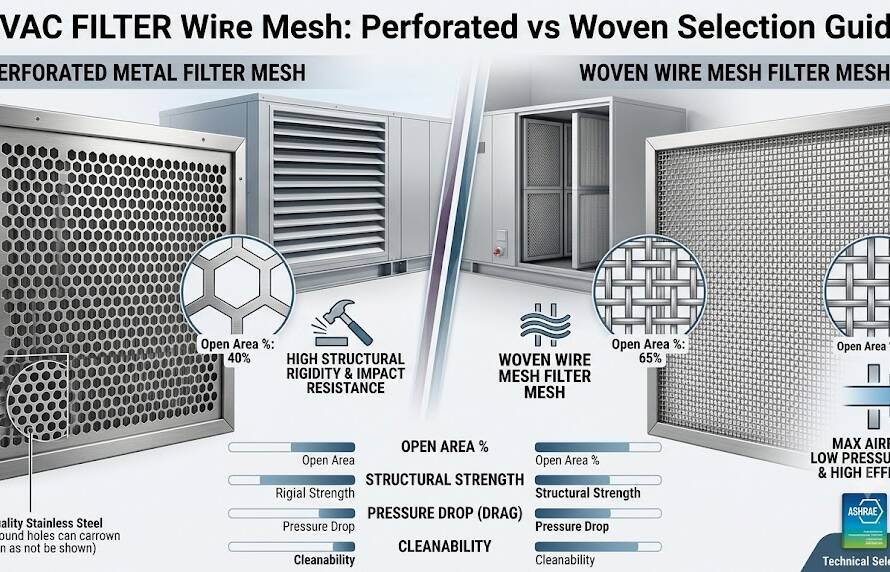
Open area is the percentage of the mesh that is open space. Higher open area = higher flow rate and lower pressure drop, but generally less strength. For liquid filtration, target 30%+ open area. For cake-forming filtration, a lower open area (15–25%) builds a thinner, more efficient cake.
4. Weave Type (covered in detail below)
Types of Wire Mesh for Industrial Filtration
Different weave patterns give the same metal drastically different filtration characteristics. Here are the four most common types used in industrial filtration.
1. Plain Weave
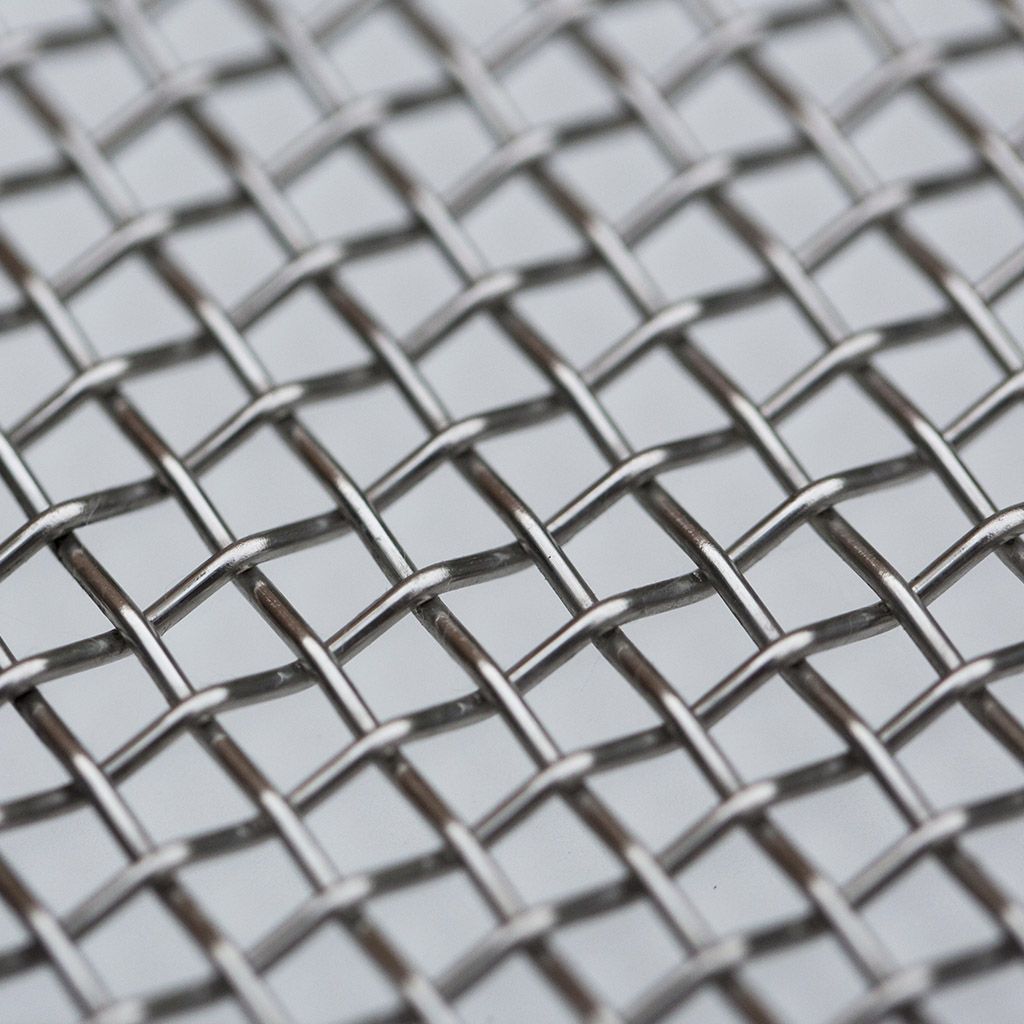
Each warp wire passes alternately over and under each weft wire. Plain weave is the most common, affordable, and accurate for square openings. See our dawai yang dikimpal for an example of plain weave construction. Best for general-purpose liquid/solid separation from 400 µm down to 75 µm.
2. Twill Weave
Each warp wire passes over two and under two weft wires, creating a diagonal pattern. Twill weave handles heavier loads and finer meshes (down to 40 µm) than plain weave, and is preferred for viscous fluids and higher-pressure applications.
3. Dutch Weave
Warp and weft wires have different diameters, producing an extremely tight, high-strength cloth with very small, tapered openings. Dutch weave is the go-to choice for fine filtration from 10 µm down to 5 µm. For finer filtration grades, explore our crimped wire mesh options. Including hydraulic oil, fuel, and polymer melt filters. Reverse Dutch weave offers even higher dirt-holding capacity.
4. Sintered Wire Mesh
Multiple layers of woven mesh (often 3–6) are diffusion-bonded (sintered) into a single rigid laminate. Sintered mesh offers excellent strength, cleanability, and a stable pore structure. It is the standard forhigh-temperature gas filtration, catalyst recovery, and filter backwash cyclesin pharmaceuticals.
| Type | Micron Range | Strength | Cleanability | Typical Application |
|---|---|---|---|---|
| Plain Weave | 75–2000 | Medium | bagus | General straining |
| Twill Weave | 40–250 | High | bagus | Polymer, paint, hydraulic oil |
| Dutch Weave | 5–100 | Very High | Moderate | Fine chemical, fuel, hydraulic |
| Sintered Mesh | 1–200 | Excellent | Excellent | Pharma, gas, catalyst |
Material Selection: Which Metal Is Right for Your Industrial Filtration Wire Mesh?
Material choice affects corrosion resistance, temperature limits, and regulatory compliance.
- 304 Stainless Steel— The default for water, food, and mild chemicals. Good corrosion resistance, cost-effective.
- 316 Stainless Steel — Adds molybdenum for superior resistance to chlorides, acids, and marine environments. Required for pharmaceutical, marine, and many chemical processes, including UAE coastal installations — see our tubular fence range for marine-grade options.
- Specialty Alloys (Monel, Hastelloy, Inconel, Titanium)— Used in aggressive chemical service (HCl, H₂SO₄, HF) or temperatures above 600°C. Significantly more expensive but often the only viable option.
Quick rule:If your process stream contains chlorides, halides, or strong reducing acids, start with 316L — not 304. The price difference is small compared to the cost of a corrosion-related failure.
How to Choose the Right Wire Mesh: A 6-Step Framework
Use this checklist to turn a vague spec into a defensible purchase order.
- Define the fluid and contaminants.What is the medium (liquid, gas, slurry), and what is the chemistry? Are particles hard, fibrous, sticky, or abrasive?
- Set the absolute retention rating.Identify the largest particle that must NOT pass through the mesh. Add a safety margin of 20–30%.
- Define operating conditions.Maximum temperature, maximum differential pressure, and flow rate.
- Match material to chemistry.Use the chemical compatibility chart from your supplier. For food/pharma, confirm FDA / USP / 3-A compliance.
- Select the weave type.Use the comparison table above. Sintered mesh for high-temperature/critical service; Dutch weave for fine liquid filtration; plain/twill for cost-driven general use.
- Validate with a sample. Request a small sample (often 100×100 mm) and run it under real conditions for at least one full production cycle before scaling up. Hubungi ABX Metal to request free samples for your filtration project.
Frequently Asked Questions (FAQ)
Q: What micron rating should I choose for my filtration application?
A: Start from the largest particle you need to remove, then choose a mesh with a micron rating 20–30% finer as a safety margin. Browse our wire mesh catalog to find the right micron rating for your application. For example, to remove 100 µm particles, specify a 70–80 µm mesh.
Q: How do I calculate the open area of a wire mesh?
A: Open area (%) = (Aperture / Pitch)² × 100, where Pitch = Aperture + Wire Diameter. Higher open area means higher flow but lower strength.
Q: Is stainless steel wire mesh better than synthetic filter media?
A: For high-temperature, high-pressure, or reusable applications, yes. Stainless mesh lasts years and is fully recyclable. Synthetic media is cheaper upfront but disposable.
Q: How often should industrial filter mesh be replaced?
A: With proper backwashing, sintered and Dutch weave meshes can last 1–3 years in continuous service. Plain weave in abrasive service may need replacement every 3–6 months.
Q: Can wire mesh be cut and shaped without fraying?
A: Yes, especially sintered mesh. For woven mesh, edges can be welded, folded, or framed. Always specify edge treatment when ordering custom-cut pieces.
Kesimpulan
Choosing the right wire mesh for industrial filtration is rarely about finding the “best” mesh — it’s about matchingweave type, micron rating, open area, and materialto your specific fluid, temperature, and pressure conditions. Use the 6-step framework above to move from a vague spec to a defensible selection, and always validate with a real-process sample before committing to a large order.
Ready to spec your filtration project? Contact our engineering team to request free samples, a custom micron-vs-open-area analysis, or a quote tailored to your process. We’ll help you avoid the most common (and costly) selection mistakes. Also read our guide on 5 Costly Mistakes When Importing Metal Products from China for a broader procurement perspective. Get in touch with ABX Metal today.