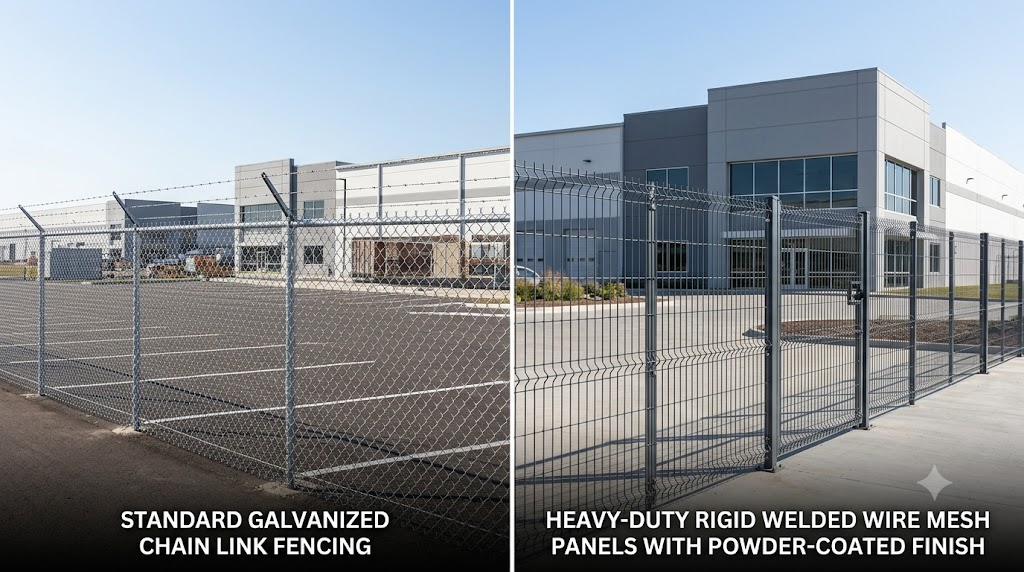
Selecting the correct perimeter barrier for commercial and industrial facilities requires balancing upfront capital expenditure against long-term security requirements. Facility managers frequently evaluate two primary wire barrier options: traditional chain link fencing и rigid welded wire mesh panels.
While chain link fencing offers lower material cost, welded wire mesh panels provide superior structural integrity, cut-resistance, and anti-climb properties.
Direct Answer: Which Fencing System Should You Choose?
Quick Summary: Choose chain link fencing for large, low-risk perimeter boundaries where basic demarcation is required at minimal initial cost. Choose welded wire mesh panels for high-risk industrial sites, logistics centers, and commercial assets requiring active intruder deterrence, anti-cut resistance, and low long-term maintenance costs.
Technical Specification & Performance Comparison
To align with modern risk-mitigation frameworks like the CEDA Site Security Guidelines, facility planners must evaluate mechanical resistance alongside material lifespan.
| Feature / Parameter | Chain Link Fencing | Rigid Welded Wire Mesh | Performance Impact |
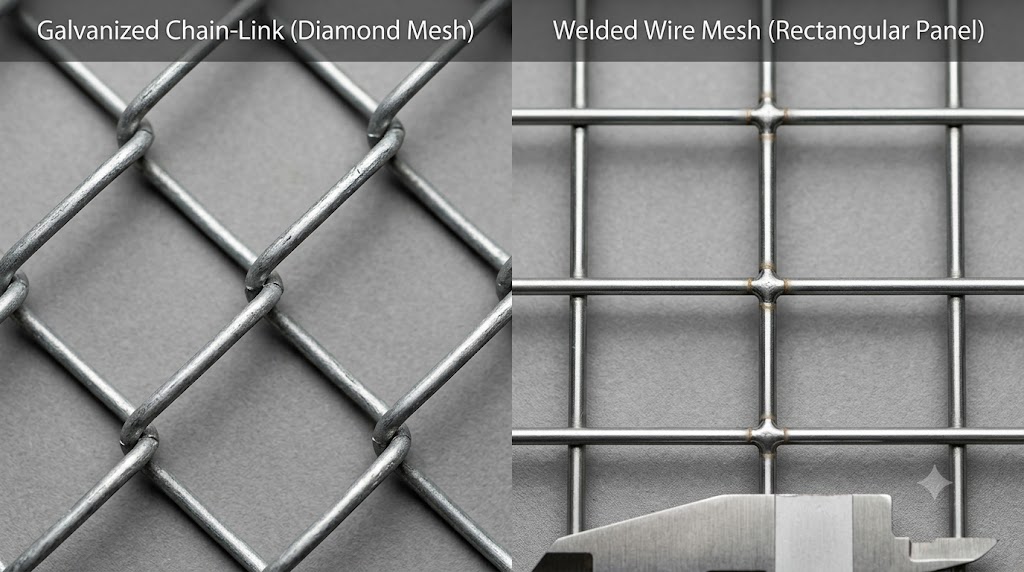
| Aperture / Mesh Size | 50mm × 50mm (Diamond) | 50mm × 200mm / 12.7mm × 76.2mm | Smaller aperture prevents handholds |
| Cut Resistance | Low (Single wire weave) | High (Welded intersections) | Welded joints remain intact if one wire is cut |
| Climb Resistance | Moderate (Flexible) | High to Extreme (Rigid panel) | Harder to scale without specialized gear |
| Structural Rigidity | Requires tension wire/rails | Self-supporting profile | Welded panels do not sag over time |
| Lifespan (Galvanized) | 10–15 Years | 20–30+ Years | Welded panels require fewer replacements |
Mechanical Integrity and Structural Defense
The core structural difference lies in joint construction. Chain link consists of interwoven helical wires that an intruder can untwist or cut with basic hand tools. Once they sever a single strand, the entire fabric unravels under pressure.
In contrast, heavy-duty rigid welded wire mesh panels feature resistance-welded intersections at every cross point. If an intruder cuts an individual wire, the surrounding mesh maintains its structural frame integrity. For critical infrastructure, facilities upgrade to dense 358 anti-climb security fencing, which eliminates toe-holds and prevents bolt-cutter insertion according to ASTM F2453 Standard Specification for Mesh Fencing.
Total Cost of Ownership (TCO) Breakdown
While standard commercial chain link fencing has a 20–30% lower initial purchase price, welded wire mesh delivers a lower total cost of ownership over a 15-year lifecycle:
- Installation Labor: Welded panels mount quickly onto pre-drilled posts using specialized security clamps, reducing field installation time compared to unrolling and tensioning chain link fabric.
- Maintenance Costs: Chain link requires frequent retensioning and repairs due to sagging or impact damage. Welded mesh panels resist localized impacts without distorting adjacent sections.
- Hardware Compatibility: Rigid welded systems integrate seamlessly with engineered fence posts and fittings, top-mounted razor wire arms, and electronic perimeter intrusion detection systems (PIDS).