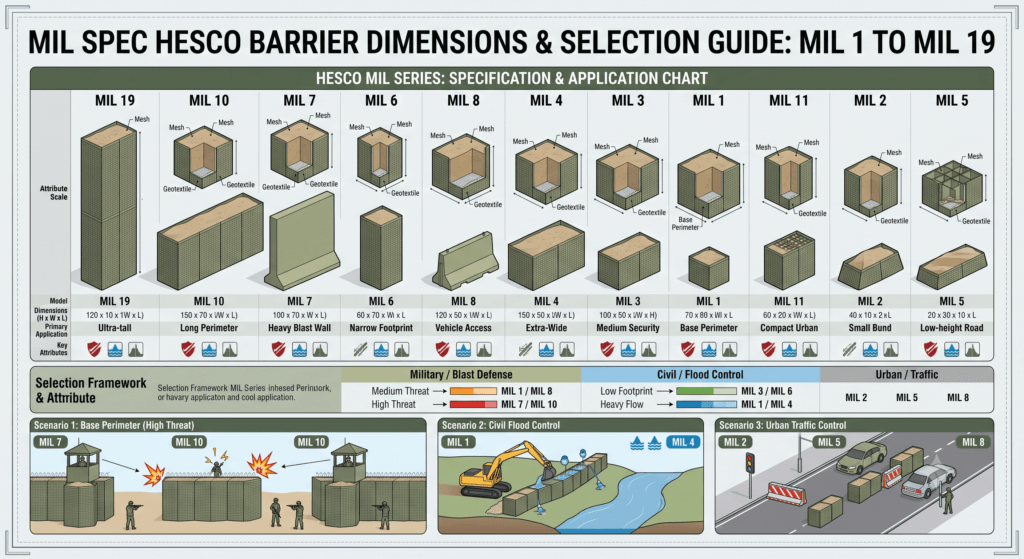
Selecting the correctMIL Spec Hesco Barrierdepends on your project’s required wall height, structural load, footprint availability, and threat profile (e.g., small-arms fire, vehicle ramming, or hydraulic flood pressure). Standard Hesco barrier models range fromMIL 1(large perimeter walls) toMIL 19(compact barrier solutions). For general military perimeter security,MIL 1 et MIL 7are the global industry standards, whereasMIL 2 et MIL 5are ideal for low-profile road barriers and bund creation.
MIL Spec Hesco Barrier Unit for Perimeter Protection (MIL 1 to MIL 19 Guide)
Complete Hesco MIL Series Specification Chart
Model
Hauteur
Largeur
Longueur
Cellules
Primary Application
MIL1
54”(1,37 m)
42”(1,06 m)
32'9" (10m)
4+5 cellules
Base perimeter walls, ammunition stores, flood levees
MIL2
24" (0,61m)
24" (0,61m)
4′ (1,22 m)
2 cellules
Small bunds, path dividers, temporary road blocks
MIL3
39”(1,00 m)
39”(1,00 m)
32'9" (10m)
5+5 cellules
Medium perimeter security, soil retention
MIL4
39”(1,00 m)
60”(1,52 m)
32'9" (10m)
5+5 cellules
Extra-wide defensive barriers, blast mitigation
MIL5
24" (0,61m)
24" (0,61m)
10′ (3,05 m)
5 cellules
Low-height road security, erosion control
MIL6
66”(1,68 m)
24" (0,61m)
10′ (3,05 m)
5 cellules
High-aspect perimeter shielding with narrow footprint
MIL7
87”(2,21m)
84”(2,13 m)
91′ (27,74 m)
4+4+5 cellules
Heavy blast walls, Forward Operating Base (FOB) protection
Ultra-tall force protection and observation post walls
Step-by-Step Selection Framework
Project Requirement
Threat / Application Level
Recommended Unit Model
Military / Blast Defense
High Threat
MIL 7 / MIL 10
Medium Threat
MIL 1 / MIL 8
Civil / Flood Control
Heavy Flow
MIL 1 / MIL 4
Low Footprint
MIL 3 / MIL 6
Recommended Models:MIL 7(2.21m high) orMIL 10.
Reasoning:The height (2.21m) shields personnel from direct line-of-sight small-arms fire, while the 2.13m width provides the structural mass needed to absorb rocket-propelled grenades (RPGs) and explosive blast waves.
Scenario 2: Civil Flood Control & Emergency Levees
Recommended Models:MIL 1 ou MIL 4.
Reasoning:MIL 1 offers an ideal balance between height (1.37m) and volume capacity, allowing rapid installation along riverbanks using standard excavators.
Scenario 3: Urban Checkpoints & Traffic Control
Recommended Models:MIL 2, MIL 5, orMIL 8.
Reasoning:These units feature a smaller base footprint (0.61 m width), making them suitable for positioning along paved roads without blocking traffic lanes.